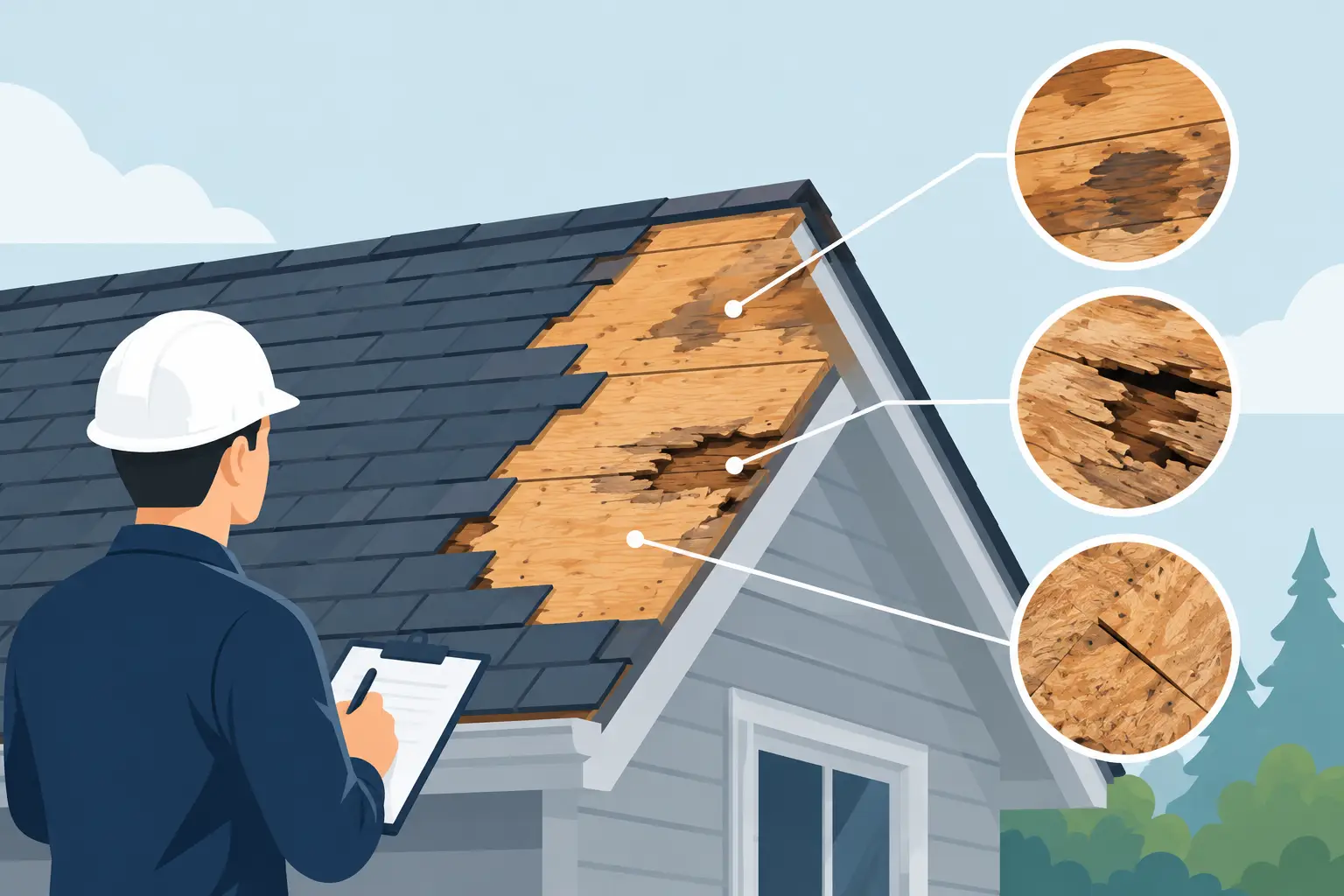
A new roof can look exceptional from the street while hidden deterioration continues below it. Knowing when to replace roof decking is essential before installing premium steel roofing, because the deck is the structural surface that receives fasteners, supports the assembly, and helps the roof perform through Canadian snow loads, rain, wind, and temperature swings.
Roof decking is not automatically replaced with every reroof. In many homes and commercial buildings, sound plywood or oriented strand board (OSB) can remain in service for decades. But covering compromised decking is a false economy. It can shorten the life of a new roof, compromise fastening, conceal active moisture issues, and create a finish that does not meet the standard expected from a high-performance installation.
What Roof Decking Does Beneath Your Roof
Roof decking, also called sheathing, spans the rafters or trusses and forms the base layer beneath underlayment and roofing material. For a steel roofing system, it provides a consistent substrate for approved fastening details and supports the roof assembly's ability to resist wind uplift and weather exposure.
Its condition affects more than structural strength. Flat, dry decking allows underlayment to lie correctly, supports clean panel alignment, and helps prevent visual irregularities in a finished steel roof. On architectural projects, minor substrate defects can become visible through long, crisp metal panels.
Decking should be assessed after the existing roofing is removed. A surface inspection from an attic can reveal useful clues, but it cannot always show damage around penetrations, valleys, eaves, or previous repairs. Those are often the areas where water has entered and remained trapped.
When to Replace Roof Decking: The Clear Signs
The most reliable answer is straightforward: replace decking when it has lost its strength, has been materially damaged by moisture, or can no longer provide a stable fastening surface. The details matter, because staining alone does not always mean the panel has failed, while seemingly small soft areas can point to a larger hidden issue.
Soft, spongy, or sagging areas
Decking that flexes under careful foot pressure, feels soft, or visibly sags between framing members should be removed and replaced. These conditions indicate that the wood fibres have weakened or that the panel is no longer adequately supported. Installing a new roof over a soft section may leave the roof vulnerable to movement and can affect the appearance of the finished surface.
From inside the building, sagging may appear as a dip in the roof plane or a bowed ceiling line. From outside, it can show up as an uneven roof surface that becomes more noticeable in low-angle sunlight.
Rot, delamination, and crumbling edges
Wood rot is a replacement condition, not a cosmetic concern. Probe suspicious areas around chimneys, plumbing vents, skylights, valleys, and eaves. If a screwdriver easily penetrates the panel, layers of plywood are separating, or OSB edges are swollen and breaking down, the affected decking has reached the end of its useful life.
Moisture damage is often most severe at panel edges and near roof penetrations. Replacing only the visible damaged portion may be appropriate when the issue is isolated, but the surrounding area must be checked carefully. Water does not always travel straight down from the point where it entered.
Persistent staining or mould from an active moisture problem
Old water stains can remain after a leak has been corrected. If the decking is dry, firm, and free of decay, staining alone may not require replacement. Persistent dampness, a musty odour, mould growth, or new staining, however, demands investigation before the roof is closed back up.
The source may be failed flashing, an ice-dam history, poor attic ventilation, plumbing condensation, or a leak higher on the roof slope. Replacing sheathing without correcting the source simply gives moisture a new surface to damage.
Loose fasteners and enlarged holes
Steel roofing depends on accurate fastening into a suitable substrate or framing arrangement, depending on the system design. Decking with stripped fastener holes, widespread splitting, or degraded material may not hold fasteners as intended. This becomes particularly important in wind-exposed locations and on roofs with complex geometry.
A contractor should not assume that new fasteners will solve a compromised panel. The correct response depends on the roof system, panel profile, framing layout, and extent of deterioration. In some cases, localized sheathing replacement is sufficient. In others, a wider section must be renewed to restore a dependable base.
Fire, insect, or structural damage
Charred decking, termite or carpenter-ant damage, severe splitting, and panels cut excessively for old mechanical work should be reviewed as structural concerns. A roof replacement is the right time to correct these issues, while the assembly is open and access is practical.
Where damage involves rafters, trusses, or load-bearing connections rather than just the sheathing, the scope moves beyond a standard reroof. Qualified structural assessment may be required before new decking and roofing are installed.
Why Steel Roofing Raises the Standard for Preparation
Premium steel roofing is valued for long service life, weather resistance, and a refined architectural finish. Those benefits rely on correct preparation below the panels. A durable roof covering cannot compensate for a decayed or uneven deck.
Metal panels also tend to make roof-plane irregularities more apparent than heavily textured roofing materials. This does not mean every minor imperfection requires full deck replacement. It means the substrate should be evaluated with the finished result in mind, especially on visible slopes, low-pitch rooflines, and custom exterior projects.
Proper deck preparation also supports water management. Underlayment, ice-and-water protection where required, flashings, ventilation details, and panel installation all work together. If moisture has damaged the decking, the project should identify why before the new steel roofing assembly is installed.
Repair or Full Replacement? It Depends on the Extent
A localized repair is often the right choice when damage is confined to a small, clearly understood area. Common examples include a section around a failed vent flashing, a limited valley repair, or an isolated spot near an eave where ice buildup caused deterioration. The replacement panel should match the required thickness, span direction, and fastening pattern for the roof structure.
Broader replacement is more appropriate when deterioration appears in several areas, the deck has widespread swelling or delamination, or inspection suggests long-term moisture exposure across a roof plane. Multiple patch repairs can create an inconsistent surface and may cost more than a planned replacement approach once labour and detailing are considered.
Age alone is not a reason to remove all roof decking. Older plank decking can remain serviceable if it is dry, structurally sound, and compatible with the selected roofing system. Its condition, spacing, fastening requirements, and any needed overlay should be reviewed before material is ordered. Building-code requirements and manufacturer installation instructions also influence the right approach.
A Professional Decking Assessment Before Installation
The most useful time to make final decking decisions is after the existing roof covering has been removed. That is when a roofing professional can inspect the entire roof plane, test questionable sections, identify moisture pathways, and distinguish isolated damage from system-wide deterioration.
For property owners and project managers, ask for clear communication on three points: what damage was found, what likely caused it, and whether the proposed repair restores a sound base for the new roof. Photos and a defined repair scope are especially valuable on larger commercial, custom residential, or architect-led projects.
A considered assessment also prevents surprises around connected work. Roof drainage, fascia condition, skylight curbs, framing modifications, and exterior structural elements can all affect the final scope. Coordinating these details before panels are installed protects both performance and finish quality.
Protect the Roof You Are Investing In
Replacing roof decking is not an upgrade to add by default, nor is it an item to defer when clear damage is present. It is a decision based on structural condition, moisture history, roof design, and the demands of the roofing system being installed.
Before committing to a new steel roof, ensure the concealed surface beneath it is dry, stable, properly detailed, and ready to support decades of service. That careful work is rarely visible once the project is complete, but it is what allows a premium roof to perform as intended.