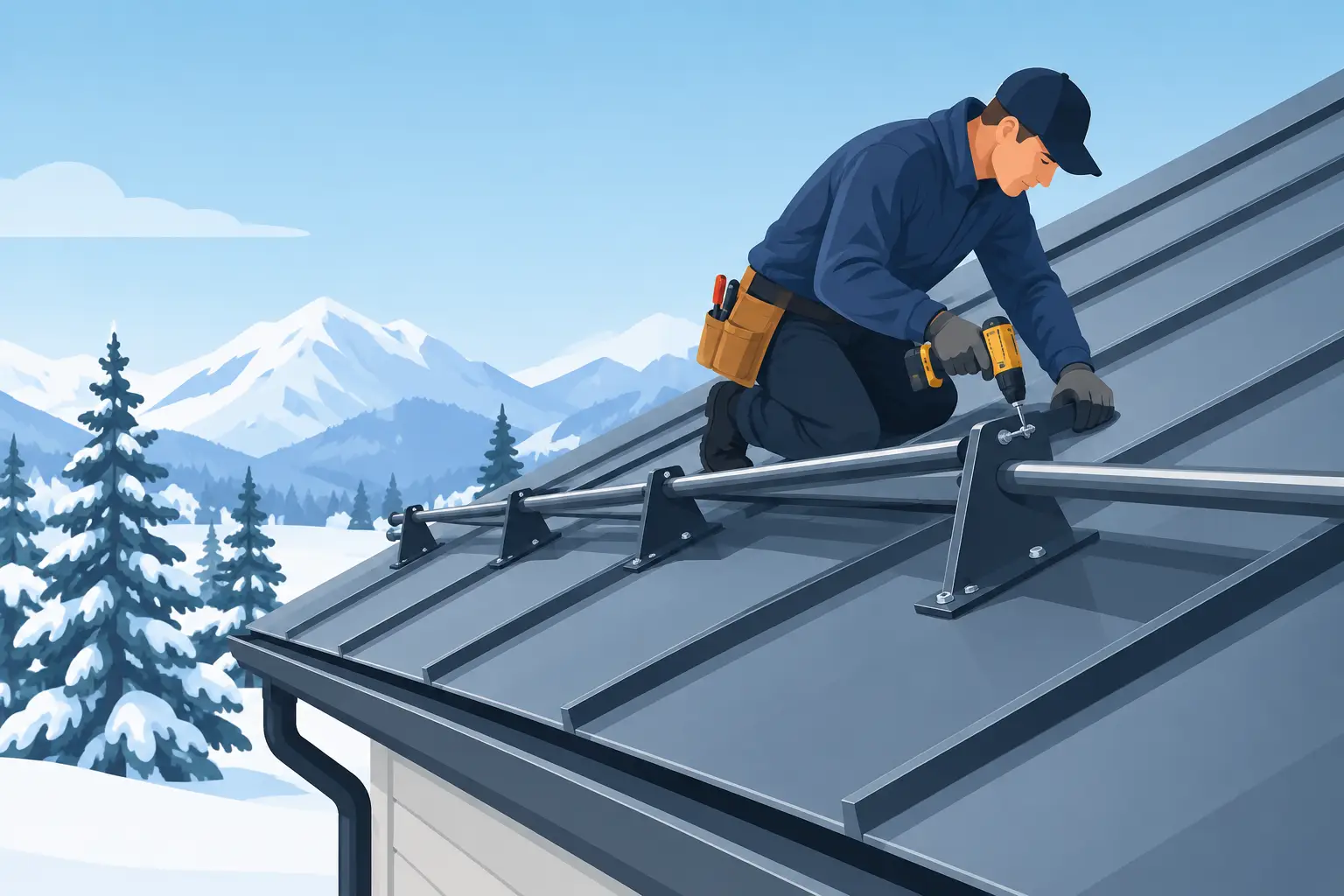
A sheet of roof snow can release without much warning. On a steel roof, it may slide as a dense, heavy mass rather than falling gradually, placing entrances, walkways, landscaping, parked vehicles, lower roofs, and gutters at risk. Proper metal roof snow guard installation is not a cosmetic add-on. It is a carefully planned retention system that must suit the roof profile, the building structure, and the snow conditions at the property.
For high-end residential, commercial, and specialty projects, the objective is not simply to stop snow. It is to manage how snow is retained, distributed, and released while preserving the roof's weather performance and architectural finish.
Why metal roofs need a snow-retention strategy
Metal roofing delivers exceptional longevity, clean lines, and reliable weather resistance. Its smooth surface also allows accumulated snow to move more readily once the lower layer warms or loses its grip. A sudden roof avalanche can be hazardous even on a modest slope. On larger roof planes, the force increases significantly.
Snow guards interrupt that movement. They divide the snowpack into smaller sections and hold it in place so it can melt or shed in a more controlled manner. Their value is highest above areas where people or assets regularly sit below the eaves, including main doors, patios, loading areas, mechanical equipment, and pedestrian routes.
The right approach depends on the roof. A low-slope standing seam roof over a sheltered side entrance presents a different challenge than a steep steel roof above a busy commercial walkway. Local snow accumulation, roof length, panel profile, insulation, solar exposure, and drainage all affect the design.
Start with the roof system, not the snow guard
A premium installation begins with confirming exactly what is on the roof. Snow guards are not universal hardware. A component designed for one standing seam profile may not fit another, and a bracket intended for exposed-fastener panels may require attachment points that do not align with a particular panel layout.
Standing seam steel roofs often use non-penetrating clamp-mounted systems. The clamps fasten to the seams rather than through the roof panels, helping preserve the roof's watertight surface when they are selected and torqued correctly. This is a strong option for many architectural metal roof systems, but it must be compatible with the seam shape, seam height, material gauge, and manufacturer requirements.
Exposed-fastener metal roofing generally requires a different method. Brackets may fasten through designated locations into structural support below, using approved fasteners and sealing details. Fastening into unsupported sheet metal is not an acceptable shortcut. It can deform the panel, create a leak risk, or fail under snow load.
Tile-profile, corrugated, and ribbed panels also require profile-specific brackets. The mounting hardware must sit correctly on the panel geometry and transfer forces where the roof assembly can support them.
Manufacturer compatibility protects the roof investment
Before hardware is ordered, review the roofing manufacturer's guidance and any applicable warranty conditions. Some systems specify approved snow-retention products, clamp styles, fastening methods, or maximum load assumptions. A carefully installed snow guard system should complement the roofing assembly, not introduce an avoidable warranty or service issue.
This matters especially on premium steel roofing, where the roof finish, panel integrity, and precise detailing are central to long-term value. A lower-cost, generic product can become expensive if it causes scratches, corrosion points, loose seams, or water entry.
Snow load and layout determine performance
The most common mistake in metal roof snow guard installation is treating layout as a simple straight line near the eaves. In reality, placement and spacing are structural decisions. Snow guards need enough capacity to resist the anticipated load across the roof plane, not merely hold the first few centimetres of snow.
Canadian conditions make this especially relevant. Snowfall patterns vary dramatically by region, but roof snow load is influenced by more than seasonal totals. Wind exposure can create drifting, roof valleys can collect additional snow, and repeated thaw-freeze cycles can produce dense, heavy snowpack. A north-facing slope may retain snow much longer than an adjacent slope receiving direct winter sun.
A qualified installer considers the roof's tributary area, pitch, panel length, local design conditions, and the snow-guard manufacturer's engineering data. Longer roof runs frequently require multiple rows or a staggered pattern to distribute the force. Valleys, dormers, changes in roof elevation, and roof-mounted equipment may require separate attention because they concentrate snow movement.
One continuous rail-style system can provide strong, visually restrained retention on many premium projects. Individual pad-style guards may be appropriate in certain applications, but they are not interchangeable with a rail system in terms of load capacity or layout. The selection should follow the project's conditions rather than appearance alone.
Plan protection below the roof edge
Snow guards protect more than people. They can reduce stress on gutters, prevent damage to lower roofs, and help preserve exterior features that would otherwise receive the full force of sliding snow.
That does not mean every eave needs identical treatment. A roof edge above open lawn may have a different risk profile than one above an entry canopy or a narrow side yard used for garbage access. The best layouts target real exposure points while maintaining an orderly appearance from the ground.
It is also worth considering drainage. Retained snow eventually melts. Gutters, downspouts, splash zones, and site grading should be able to manage that water. In areas susceptible to ice buildup, the snow-retention plan should be coordinated with eave detailing and any roof heating strategy rather than treated as an isolated accessory.
Installation details that separate good work from costly repairs
The hardware itself is only part of the work. Precise installation protects both the system and the roof beneath it.
First, the roof surface should be clean and free from debris that could interfere with clamps, seals, or bracket seating. Installers then set out rows accurately, keeping the system aligned with seams, ribs, and the architectural rhythm of the roof. Small layout inconsistencies can be highly visible on a refined metal roof.
For clamp-mounted systems, clamp position and torque matter. Under-tightening may allow movement under load, while over-tightening can damage the seam or panel coating. For penetrative systems, fastener type, length, substrate engagement, washer condition, and sealing procedure must all follow the approved assembly.
Care is equally important when handling finished steel. Dragged tools, careless foot traffic, or incompatible metals can compromise the coating and create future corrosion concerns. Experienced metal-roof crews use methods that respect the panel finish from setup through final inspection.
After installation, the system should be checked for alignment, secure attachment, consistent spacing, and clearance from roof features. The work should look intentional from every visible elevation, not improvised after the roof was complete.
When to install snow guards
Snow guards can be installed as part of a new metal roof project or added later. Integrating them during the roofing scope is usually the cleanest option because roof type, structural support, access, and visual layout can be coordinated from the beginning.
Retrofit work can also be effective when the existing roof is in sound condition and the correct compatible system is available. It requires a more detailed assessment, particularly if the panel manufacturer, profile, age, or prior roof modifications are uncertain. The goal is never to force a solution onto a roof that cannot support it properly.
Timing matters. Installation is best completed before winter snow accumulation. Working on a dry, accessible roof allows installers to inspect the surface closely and complete fastening or clamping with the required accuracy.
A specialized approach is worth the investment
Snow guards are relatively small components, yet they influence roof safety, drainage, appearance, and long-term performance. That is why the lowest-priced hardware-and-labour quote is rarely the right benchmark. The useful question is whether the proposed system is engineered for the roof, compatible with its panels, and installed by a team that understands steel roofing assemblies.
Double A Multi-trade approaches snow retention as part of the complete exterior system. For clients investing in premium steel roofing and custom structural craftsmanship, that level of coordination helps protect the finish and function of the entire project.
If snow regularly slides above a door, walkway, vehicle area, or lower roof, do not wait for the next release to reveal the risk. A site-specific assessment can identify where snow retention belongs, what system the roof can support, and how to achieve a result that performs as cleanly as it looks.