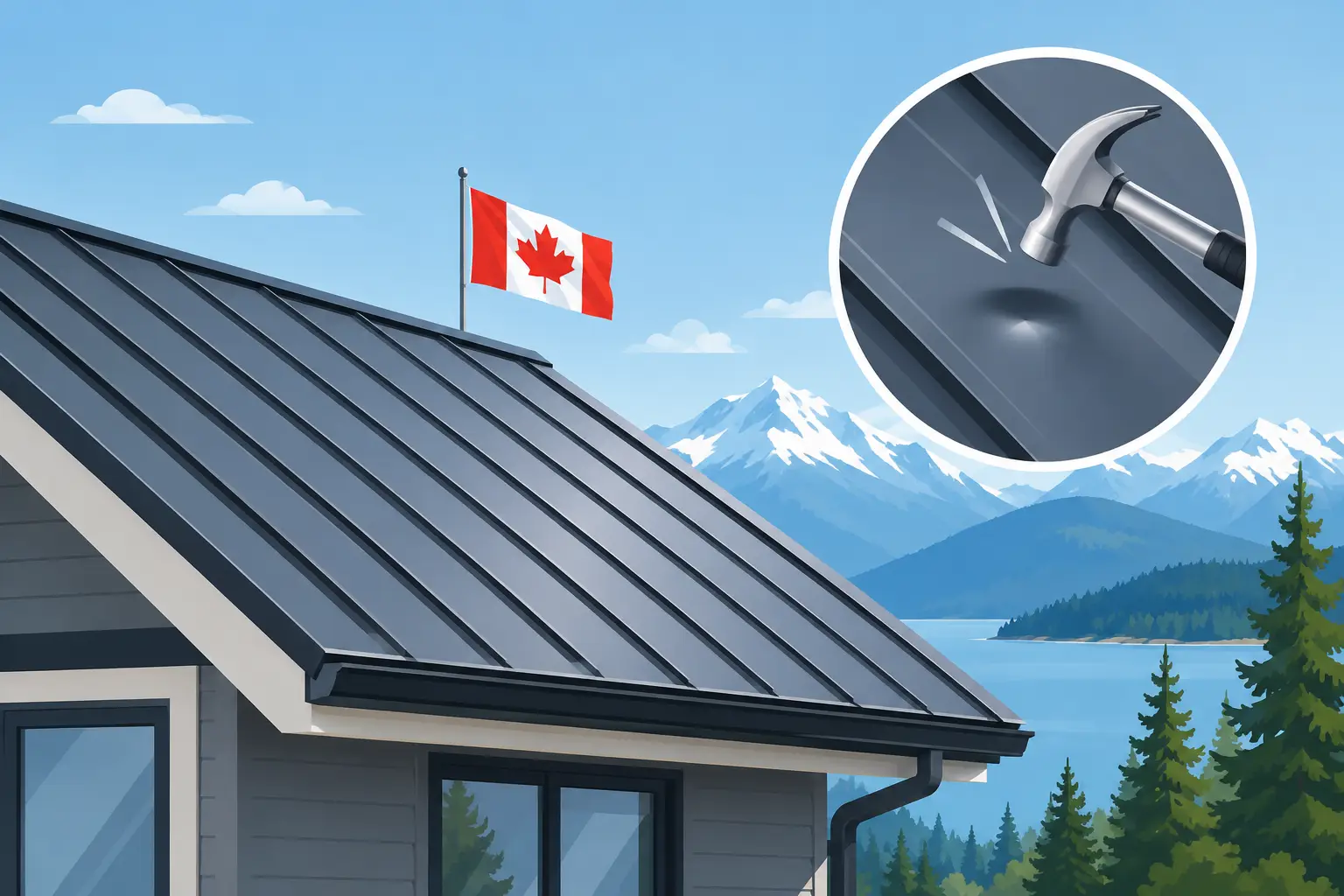
A steel roof can take a great deal of weather, but it is not indestructible. Do metal roofs dent? Yes, they can - particularly when struck by large hail, falling branches, misplaced ladders, or concentrated impact. The more useful question for a property owner is how likely denting is, how visible it will be, and what decisions at the specification stage can reduce the risk.
For Canadian homes and commercial properties, that distinction matters. A roof must contend with freeze-thaw cycles, high winds, heavy snow loads, and seasonal storms. A premium metal roofing system is selected for long service life and refined appearance, so dent resistance should be considered alongside water management, structural support, finish quality, and architectural intent.
Do Metal Roofs Dent More Easily Than Other Roofs?
Metal roofing does not automatically dent more easily than other roofing materials. It responds differently to impact. Asphalt shingles may lose granules, crack, or tear. Concrete tile can fracture. Wood shakes can split. Steel panels can deform under a sufficiently forceful strike, but a dent is often localized rather than a sign that the roof has lost its ability to shed water.
The outcome depends on the panel, not simply the category of material. Thin metal with a broad, flat profile will show an impact more readily than heavier-gauge steel formed with ribs, striations, or standing seams. A roof system installed over an appropriate, well-supported substrate also performs differently from one with inadequate backing or poorly planned structural details.
This is why comparing metal roofing only by price can lead to the wrong conclusion. A lower-cost panel may still be steel, yet offer a noticeably different level of visual resilience than a properly specified premium system.
What Determines Whether a Steel Roof Will Dent?
Several factors work together to determine dent resistance. Material thickness is one of the most direct. Steel roofing is commonly discussed by gauge, where a lower gauge number generally indicates thicker steel. Heavier-gauge panels have greater resistance to deformation, although thickness alone does not define a roof's performance.
The profile matters just as much. Standing seam roofing, corrugated panels, ribbed profiles, and panels with formed striations gain stiffness from their shape. Those formed details can help distribute force and make minor irregularities less apparent from ground level. By contrast, wide smooth pans provide a clean contemporary look but may reveal dents more clearly under low-angle light.
The substrate below the panel is another major consideration. Solid deck applications and systems installed over purlins or framing each require precise detailing. If there is insufficient support beneath an impact point, a panel has more opportunity to deflect. Proper fastening patterns, clip systems, panel allowances, and edge details also help the roof manage thermal movement without creating unnecessary stress.
Finish and colour can change what the eye sees. Deep charcoal, black, bronze, and other darker finishes may make shallow dents more visible in certain light conditions. Textured or matte finishes can be more forgiving than highly reflective surfaces. This is not a reason to avoid a preferred colour, but it is worth discussing when visual perfection is a priority.
Finally, the nature of the impact is decisive. Small hail can leave little or no visible evidence on a quality steel roof. Larger hailstones, especially those driven by wind, can dent even heavy-gauge material. A falling limb, a dropped tool, or someone walking carelessly on unsupported areas can create more focused damage than a typical storm.
Hail and Metal Roof Denting in Canada
Hail is the concern most often raised by Canadian clients, and reasonably so. Storm severity varies significantly by region, while a single intense event can affect every exposed surface of a property. No roofing product can honestly be described as immune to extreme hail. The goal is to select a system with an appropriate level of impact resistance for the site and the owner's expectations.
Many metal roofing products are tested and classified for impact performance. Those ratings can be useful, but they should not be treated as a complete design decision. They do not replace an assessment of the panel's gauge, profile, finish, roof slope, surrounding trees, and the building's overall exposure.
A dent after hail also does not necessarily mean a roof is leaking or needs immediate replacement. The panel's protective coating, seams, flashings, and fasteners should be inspected after a severe event. Cosmetic damage and functional damage are not the same thing. A qualified assessment establishes whether the issue is visual, whether the coating has been compromised, and whether a repair or insurance claim is warranted.
Design Choices That Improve Dent Resistance
The strongest approach starts before material is ordered. For a property in an exposed area, a roofing specialist may recommend a heavier steel panel, a more structured profile, or a finish that better suits the site's conditions. The right choice should support both the building's architecture and its long-term maintenance plan.
Roof geometry deserves attention as well. Valleys, transitions, skylights, chimneys, parapets, and low-slope connections concentrate technical demands. Well-executed flashing and drainage details do not make a panel dent-proof, but they protect the roof's primary purpose: managing water reliably. They also ensure that any future service work can be carried out without damaging finished surfaces.
Tree management is often overlooked. Mature trees add value to a site, yet deadwood and overhanging limbs can become a direct risk during wind and ice events. Pruning should be part of a broader property-maintenance strategy, particularly where a premium roof is intended to perform for decades.
For commercial and specialty projects, coordination with structural work is equally valuable. Roof framing, purlin spacing, edge support, equipment curbs, and access routes should be planned as connected elements. This is where custom structural craftsmanship can protect both the appearance of the roof and the efficiency of the broader build.
Can a Dented Metal Roof Be Repaired?
It depends on the panel system and the location of the damage. Small dents in an accessible panel may be purely cosmetic and may not require intervention. In other cases, individual panels can be replaced, though replacement should be approached carefully on interlocking or standing seam systems to avoid disturbing adjacent panels, flashings, or weatherproofing details.
Attempting to push out a dent without understanding the panel profile, coating, and fastening system can create a larger problem. The finish may crack, the panel may oil-can, or concealed clips and seams may be affected. A professional inspection is the appropriate first step, especially after hail or impact damage near a seam, valley, penetration, or roof edge.
Owners should also document the condition promptly with clear photographs after a significant weather event. This supports an informed conversation with an insurer and gives a roofing specialist a useful baseline. Avoid allowing unqualified trades or maintenance personnel to walk across panels before the system has been assessed.
A Better Standard Than “Dent-Proof”
“Dent-proof” is not a realistic promise for any refined exterior material exposed to Canadian weather. A better standard is a roof designed to resist ordinary impacts, retain its weather protection, and age with a finish that continues to suit the property.
That comes from matching panel selection to the site, supporting it with accurate structural and flashing details, and installing it with discipline. Double A Multi-trade approaches premium steel roofing as part of the building envelope, not as a commodity layer applied at the end of construction. For owners and project teams, that level of coordination is what turns a durable material into a long-term roofing investment.
When dent resistance is a concern, make it part of the early design conversation. The right steel gauge, profile, substrate, and installation method can preserve the clean architectural finish you expect while preparing the roof for the conditions it will actually face.